Liz Carpenter had three simple rules for writing a successful speech:
• Start with a laugh to put the audience in a good mood and get their attention.
• Put the meat in the middle by addressing your main points.
• Wave the flag at the end by inspiring and motivating the group to take action.
That’s pretty good advice, upon which Carpenter elaborated in her practical, charming and often funny 2000 book, “Start with a Laugh.” The book is filled with lessons learned, tried-and-true advice and wonderful anecdotes from the author’s long public life including, of course, her days in the Johnson White House.
For example, I chuckled when I read Carpenter’s advice for handling quotations, which stemmed from LBJ’s reaction to a quote someone put in one of his speeches.
“LBJ was so determined to make his words understood by the people that once, when he came upon a speech draft quoting Aristotle, he turned to the startled writer and said. ‘Aristotle? Those folks don’t know who the hell Aristotle is.’ Then he took his pen, crossed out the reference to Aristotle and wrote in, ‘as my dear old daddy used to say.’”
When Carpenter died last week, most of the obituaries identified her as Lady Bird’s former press secretary. But she also should be remembered for writing the 58 impactful words that a clearly shaken LBJ spoke when upon arriving at Andrews AFB on that terrible day in November 1963:
"This is a sad time for all people. We have suffered a loss that cannot be weighed. For me, it is a deep personal tragedy. I know that the world shares the sorrow that Mrs. Kennedy and her family bear. I will do my best. That is all I can do. I ask for your help and God's."
Typically humble, Carpenter was reluctant to take credit for those words. “God was my ghostwriter,” she said.
Showing posts with label speechwriting. Show all posts
Showing posts with label speechwriting. Show all posts
Wednesday, March 24, 2010


Saturday, November 7, 2009
Help for the exec who can't say 'No'
I once worked with a Fortune 100 CEO I affectionately called "The CEO who couldn't say no."
He answered to a demanding board. His company had operations, customers and employees in almost every country. He was a smart guy and a dynamic leader. He was a skilled communicator, who truly believed that communicating was a critical part of his job and a means to accomplishing everything in his all-encompassing job description. Great, right?
So here's the downside: He said yes to just about every speaking opportunity his secretary could crowbar into his schedule. Employee meeting in Florida? Yes. Ribbon cutting in India? Sure. A few words at Joe's retirement party? Absolutely! Sales conference, press event, trade show? Yes, yes and yes. Service club meeting in a town in which his company no significant presence? What the heck.
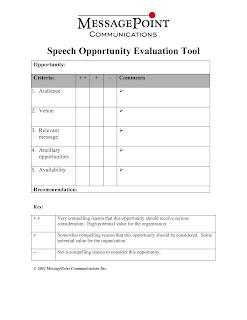
Word spread quickly that he was a willing and capable speaker, so the number of invitations multiplied. With the support of his VP of Communications, I developed a simple Speech Opportunity Evaluation Tool to help separate the wheat from the chaff ... or in this case the important stakeholders from the Rotarians.
The tool helps speakers, communications advisers and speechwriters evaluate speaking opportunities along five dimensions:
The tool helps speakers, communications advisers and speechwriters evaluate speaking opportunities along five dimensions:
1. Audience. Is the audience made up of influential people important to the organization’s success? Is the audience size appropriate (i.e., are we reaching enough people to make it worth the executive’s time?)?
2. Venue. Is this a premium venue (e.g., top conference, forum, university, etc.)? Who else is on the program? Who else has spoken at this forum in the past?
3. Relevant message. Do we have something important and relevant to say on the topic being covered or to the audience assembled? Is the topic important to us? Is the executive an authority on the topic?
4. Ancillary opportunities. Can this speech be merchandised through reprints, publications, web postings, etc., or can valuable publicity be gained through the executive’s participation? Are there other things that the executive can accomplish in the same geographic area as the speaking opportunity (e.g., customer meetings, editorial board meetings, media interviews, employee location visits, etc.)?
5. Availability. Is the executive’s schedule open? If not, how does the importance of this opportunity stack up against other scheduled events? If not, should we consider offering a substitute?
The tool helped us inject a little discipline in the CEO's decision-making process. Sometimes it worked; sometimes he thanked us for our input as he headed out for the Optimist Club luncheon.
Subscribe to:
Posts (Atom)


